How Many Przewalski's Horses Are Left?
A dozen horses in zoos became roughly two thousand across three countries. Here is the current count, site by site, and how it climbed.
 Written with Bat-Erdene Ganbaatar, Hustai National Park tour guide and wildlife specialist
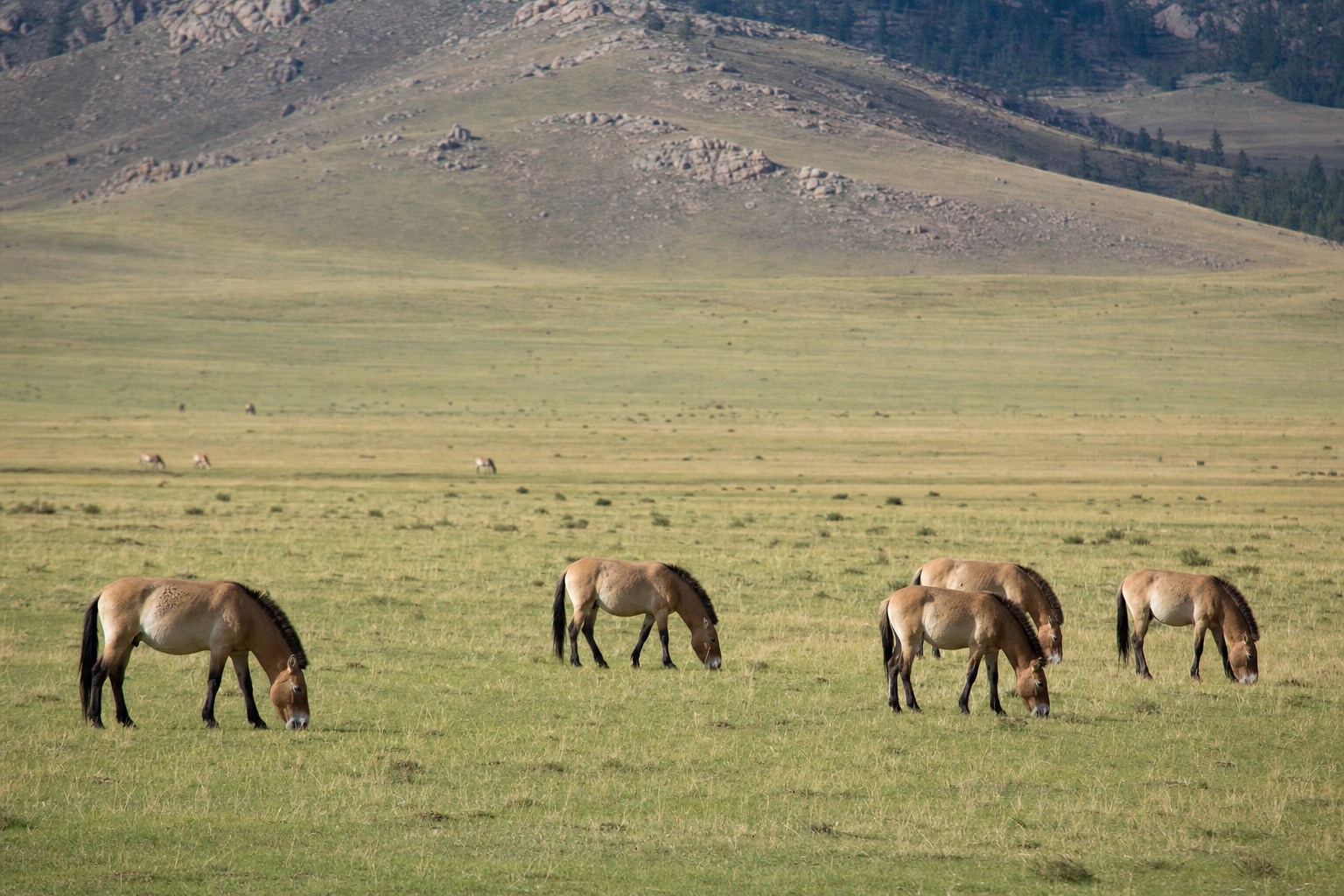
How many Przewalski's horses are left?
Around 2,000 Przewalski's horses are left worldwide as of 2026, all descended from about a dozen founders. The largest wild herd, roughly 380 to 450, lives at Hustai National Park in Mongolia. Others roam the Great Gobi B reserve, China, Russia, and the Chernobyl exclusion zone.
The number that stops people cold is not two thousand. It is twelve. That is roughly how many horses the entire species passed through in the mid-twentieth century, a founder group small enough to fit in a single paddock. Everything alive today traces back to that bottleneck. When a guest asks me how many takhi are left, I start with the twelve, because it makes the rest of the count mean something.
How many Przewalski's horses are left?
As of 2026, roughly 2,000 Przewalski's horses are left in the world, with some counts near 1,900. All of them descend from about a dozen wild-caught founders that survived in captivity. The largest single wild herd, around 380 to 450 animals, lives at Hustai National Park in Mongolia, with other free-ranging groups in China, Russia, and the Great Gobi B reserve.
That total is a conservation milestone measured against zero. The takhi was extinct in the wild by 1969, so for a stretch of the twentieth century the wild count was literally none. The Smithsonian's National Zoo puts the living total near 1,900, while other 2024 to 2026 sources round it to about 2,000. Either way, the figure climbed from a founder group of roughly 12 to 14 horses, which is why geneticists watch the population's health so closely. For the biology behind that recovery, our complete guide to the takhi fills in the science.
Where do the surviving horses live?
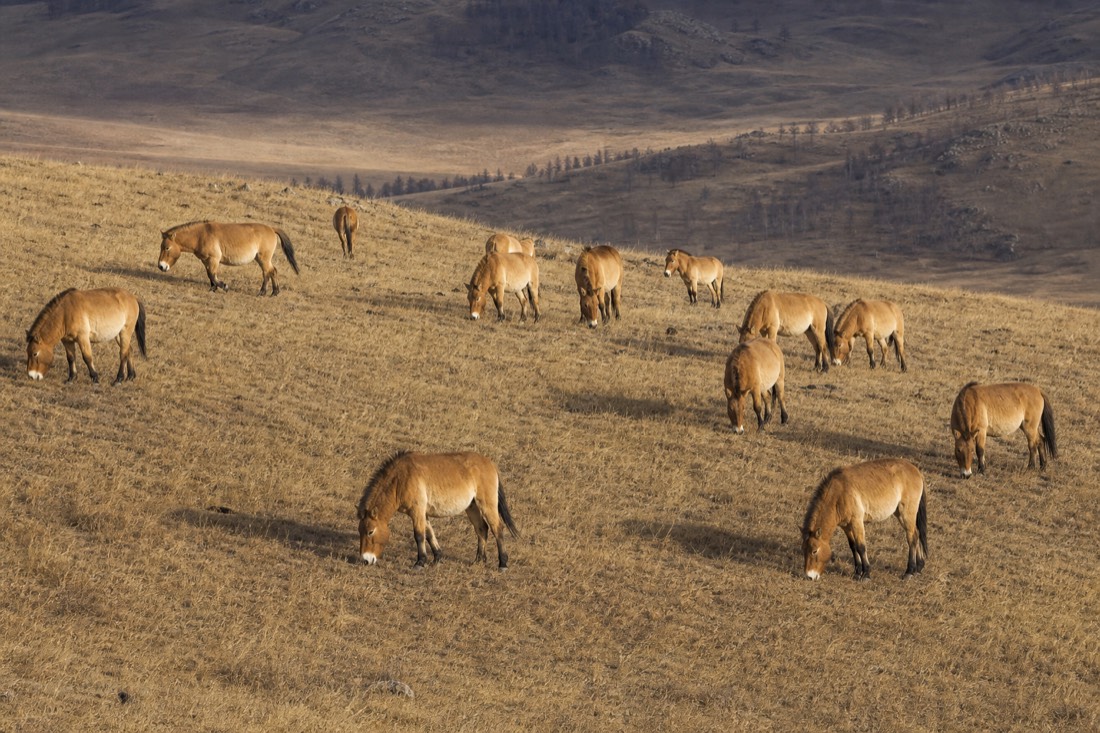
The population is split across Mongolia, China, and Russia, plus a free-roaming herd in the Chernobyl exclusion zone. Hustai National Park holds the largest wild group at 380 to 450, the Great Gobi B reserve over 350, China more than 900, and Russia's Orenburg steppes around 125. The remainder live in zoos and breeding centres worldwide.
The spread is deliberate. Concentrating every takhi in one valley would leave the species one bad winter away from disaster, so herds were established across several countries. China now holds the largest national share after decades of its own reintroduction. The Chernobyl population is the strangest chapter: horses released into the abandoned zone in 1998 have bred and now range freely through the radioactive but human-empty landscape, a story we tell in full in our Chernobyl takhi feature.
| Location | Approximate population | Status |
|---|---|---|
| Hustai National Park, Mongolia | 380 to 450 | Largest wild herd |
| Great Gobi B, Mongolia | 350+ | Free-ranging |
| China | 900+ | Roughly a third of the total |
| Russia (Orenburg) | ~125 | Reintroduced herd |
| Chernobyl exclusion zone | Free-roaming since 1998 | Self-breeding |
| Zoos and centres worldwide | Remainder of ~2,000 | Captive breeding |
Mongolia remains the species' true home, and Hustai its flagship. Why that one park matters so much is the subject of our overview of Mongolia's wild horses.
How did the numbers grow over the decades?
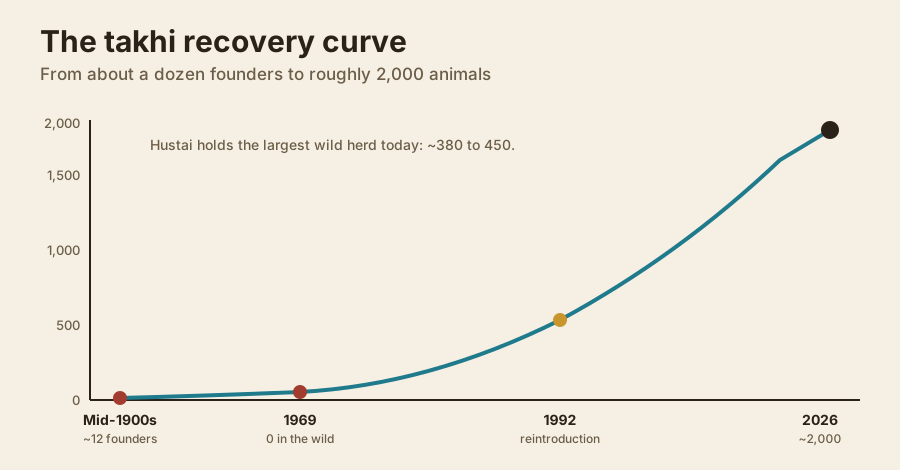
The takhi fell to about a dozen founders in the mid-1900s and vanished from the wild by 1969. Captive breeding rebuilt the numbers through the late twentieth century. Reintroduction to Mongolia began in 1992, and free-ranging herds have grown steadily since, reaching roughly 2,000 animals worldwide by 2026.
The recovery was not a straight line. Small founder populations carry heavy genetic risk, and early reintroduced herds faced brutal Mongolian winters, one of which killed a large share of the reintroduced Gobi horses in the early 2000s. That the species pushed through those losses is the whole point of the comeback, chronicled in our takhi comeback story.
| Period | Wild population | What was happening |
|---|---|---|
| Mid-1900s | ~12 to 14 (captive only) | Last founders taken into zoos |
| 1969 | 0 in the wild | Declared extinct in the wild |
| 1992 onward | Herds re-established | Reintroduction to Hustai begins |
| 2026 | ~2,000 total worldwide | Free-ranging across three countries |
What conservation status does the takhi hold?
Przewalski's horse is currently classed as endangered on the IUCN Red List, upgraded from critically endangered in 2011. Before that it was listed as extinct in the wild for decades. The status changes track the reintroduction directly: as free-ranging herds grew and bred, the species moved off the very edge.
Those reclassifications are among the clearest wins in large-mammal conservation. The IUCN Red List entry logs the move to critically endangered in 2008 and to endangered in 2011. It is still endangered, not safe, but the direction of travel is unusual and worth respecting.
| Period | IUCN status |
|---|---|
| Late 1900s | Extinct in the wild |
| 2008 | Critically endangered |
| 2011 to present | Endangered |
Why are the takhi numbers watched so closely?
Because the whole species passed through an extreme genetic bottleneck. Every living takhi descends from about a dozen founders, so inbreeding is a permanent concern. Conservationists manage breeding across countries to spread the limited gene pool as widely as possible, and the count is tracked herd by herd to catch any decline early.
A founder group that small leaves a lasting mark. With so few ancestors, harmful traits can concentrate and fertility can suffer, which is why breeding books and international coordination matter as much as the raw headcount. The number 2,000 sounds comfortable until you remember it grew from twelve, and that the animals are still working through the consequences of that squeeze. Spreading herds across Mongolia, China, Russia, and Chernobyl is partly insurance against disaster and partly a way to keep separate breeding lines alive.
The count also moves for a blunt reason: weather. A severe Mongolian winter, known here as a dzud, can kill a large share of a herd in a single season, as happened to the early Gobi reintroduction in the 2000s. So a figure that reads as steady growth on paper can hide a hard year and a rebound. That is why the honest way to give the number is as a recent estimate, not a fixed fact.
How reliable is the count?
The figures are estimates, not a perfect census. Free-ranging herds move across large areas, foals arrive each spring, and losses happen quietly in winter. The park and conservation bodies count regularly, but any single number is a recent snapshot. Ranges like Hustai's 380 to 450 reflect different counts and dates rather than disagreement.
When you see one source say 380 and another say 450 for the same park, both can be right. One may be an official harem tally, another a more recent travel or conservation report after a good breeding season. Neither is wrong, they are just clocks reading slightly different times. Treat the global 2,000 the same way. It is the best current picture, and it will read differently next year, almost certainly higher if the herds keep breeding as they have.
Is the takhi safe now, or still at risk?
Still at risk. Around 2,000 animals across a handful of sites is a fragile total for a whole species, and the takhi remains classed as endangered rather than recovered. Continued protection, careful breeding, and the spread of herds across countries are what keep the trend positive. Take away that management and the gains could reverse.
The comeback is real, but it is not finished. A species rebuilt from a dozen founders needs decades more of steady work before anyone calls it secure, and a single catastrophic winter or disease outbreak in a concentrated herd could undo years of progress. That is the honest frame: a genuine success story that is still being written, not a closed case. Every foal born wild at Hustai or the Gobi widens the margin a little further.
How does the global total break down by category, not just by site?
Split the roughly 2,000 living takhi by category rather than location and the picture sharpens: around 730 to 800 in Mongolia's two free-ranging parks combined, 900+ free-ranging in China, about 125 in Russia, an uncounted free-roaming group in Chernobyl, and the remainder held in zoos and breeding centres worldwide.
Site-by-site tables are useful, but this cut answers a different question: how much of the species actually lives wild, versus how much is still insurance stock in captivity. Mongolia and China between them account for the overwhelming majority of every free-ranging takhi on Earth, which is exactly what conservationists intended when they chose these two countries as the primary reintroduction targets in the 1990s.
A visitor booking a day trip to Hustai is, in effect, choosing the site with the longest continuous free-ranging history of any of them. The park's herd has been building since the first horses arrived in 1992, more than three decades of uninterrupted breeding in the wild, while China's and Russia's programmes, though larger or newer in different ways, do not offer the same combination of scale, accessibility, and depth of established wild behaviour that Hustai's harems now show.
| Category | Approximate share of ~2,000 total | Notes |
|---|---|---|
| Free-ranging, Mongolia (Hustai + Great Gobi B) | ~730 to 800 | The two founding reintroduction sites |
| Free-ranging, China | 900+ | Largest national share |
| Free-ranging, Russia (Orenburg) | ~125 | Newer programme |
| Free-roaming, Chernobyl exclusion zone | Uncounted in current sources | Self-sustaining since 1998, outside formal tallies |
| Captive, zoos and breeding centres worldwide | Remainder of ~2,000 | The genetic reserve behind every reintroduction |
The captive share is not a footnote, whatever the smaller number suggests. Every free-ranging population on this list, Hustai included, exists only because zoos and breeding centres kept the species alive through the twentieth century and continue to hold genetic diversity that no single wild site can carry on its own. If a severe winter or a disease outbreak hit Hustai hard in a single bad year, the species would not vanish with it, because the captive reserve and the other free-ranging sites still hold the line. That redundancy, built deliberately across three countries and dozens of institutions, is the real reason the takhi survived a bottleneck that has ended other species outright.
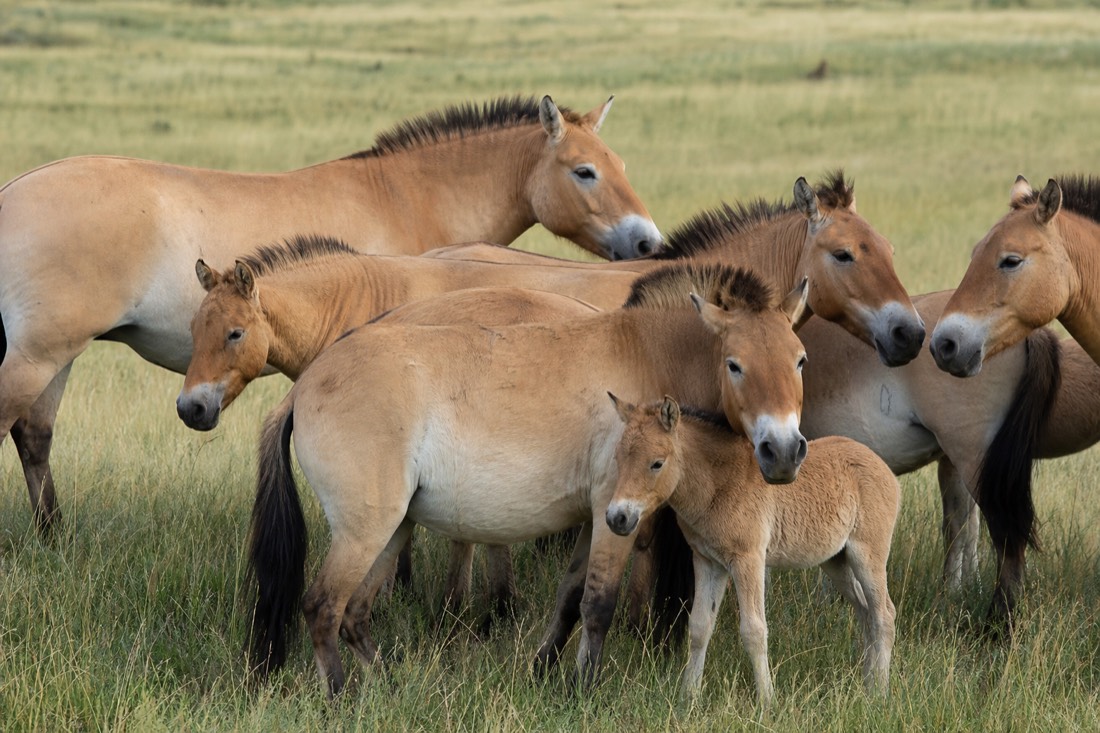
What actually happened, decade by decade, to shrink and then rebuild the count?
The bottleneck ran from roughly 1898 to 1960 as the last wild takhi were captured. The species hit zero in the wild by 1969. Reintroduction began in 1992, survived a brutal winter die-off in the reintroduced Gobi herd in the early 2000s, and had climbed to roughly 2,000 worldwide by 2026.
Laid out year by year rather than as a single population curve, the recovery looks less like a straight climb and more like a species that kept absorbing hits and rebuilding anyway.
| Year or period | Event |
|---|---|
| 1898 to 1947 | Wild-caught founders captured (narrower estimate: 12 survivors) |
| 1910 to 1960 | Wild-caught founders captured (wider estimate: 14 survivors) |
| 1969 | Declared extinct in the wild |
| 1992 | First takhi reintroduced to Hustai National Park |
| 1998 | Takhi released into the Chernobyl exclusion zone establish a free-roaming herd |
| Early 2000s | A severe Mongolian winter kills a large share of the reintroduced Gobi herd |
| 2008 | IUCN reclassifies the species as critically endangered |
| 2011 | IUCN reclassifies the species as endangered |
| 2026 | Roughly 2,000 takhi worldwide, all descended from the same founders |
The early-2000s Gobi die-off is worth pausing on, because it explains why every population figure in this guide carries the word "estimate." Mongolia's harsh winters, known locally as a dzud, can bury grazing land under ice and snow deep enough that horses cannot reach the grass beneath it. A severe dzud in the early reintroduction years wiped out a large share of the horses that had been moved to the Gobi, a loss that could have ended the whole project if the Hustai population and the captive reserve elsewhere had not still been standing. The species pushed through it, but the episode is a real reminder that a headline number like "2,000" sits on top of a history that has already included at least one near-catastrophic setback since reintroduction began, and will almost certainly include another before the recovery is considered permanently secure.
What does the recovery actually look like on the ground at Hustai? Bat-Erdene's view
Numbers on a page do not capture what changes year to year at Hustai. Since I started guiding here in 2022, I have watched harems hold their ground through winters and come back out with new foals every spring, which is the recovery in a form you can actually see.
A population count is an abstraction until you have stood on the same ridge across several seasons and watched the same stretch of valley. I have, in every season the park sees, from the short green window of spring foaling through the long grey stretch of winter when the herds thin out and every sighting counts double. Certain harems I have pointed out to visitors in one year are still there the next, sometimes larger, sometimes down a horse after a hard winter, but present. That continuity is what the raw figure of 380, or 450, or 2,000, is actually describing when you strip away the arithmetic: specific animals, in specific valleys, still there.
What strikes visitors most, when I explain it this way, is how recent all of it is. A guest in their sixties was alive for the entire stretch when Przewalski's horses existed nowhere in the wild. The recovery is not ancient history. It happened, and is still happening, inside a single working lifetime, which is not something you can say about most conservation stories on this scale.
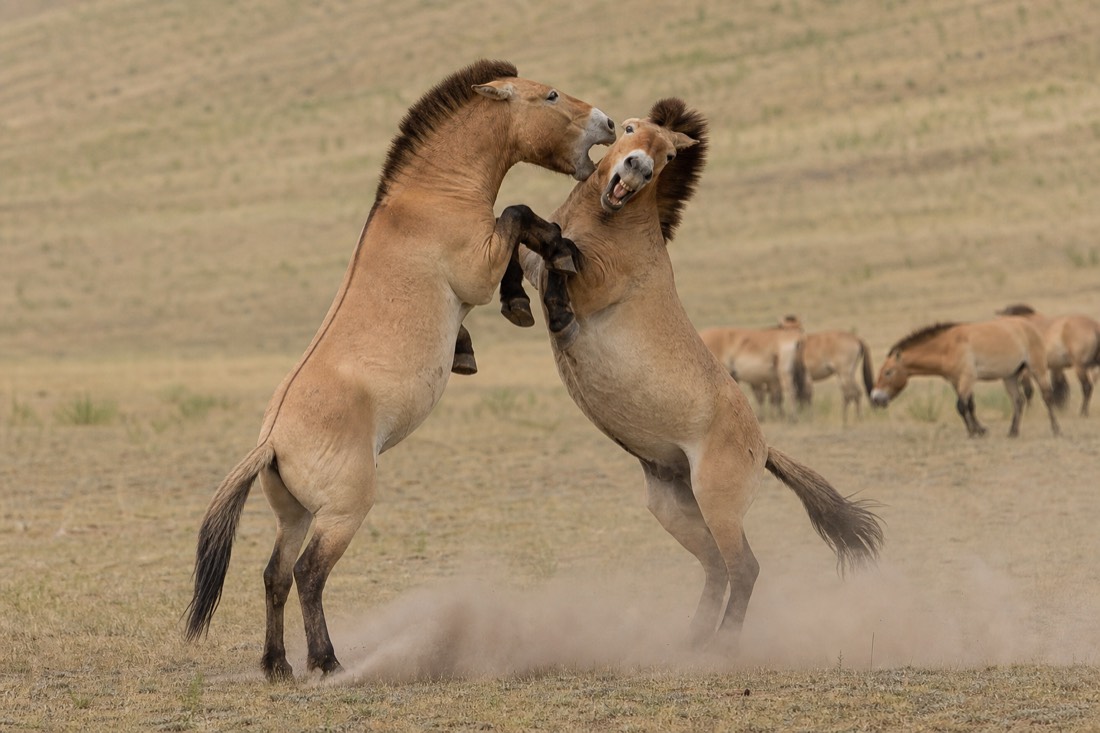
I get asked the population question differently depending on who is in the vehicle. Families with children usually want the simple version, a dozen horses becoming two thousand, told like a story with a happy ending. Photographers and the more research-minded travellers want the caveats, the range between 380 and 450 at Hustai, the reason the global figures disagree. I give both groups the true answer, just at different resolutions, because the honest number holds up either way you tell it.
Why don't all the published sources agree on the same total?
They measure different things at different times. The Smithsonian's figure of roughly 1,900 counts all living takhi, a 2024 genome study puts the global figure nearer 2,000, and an older San Diego Zoo factsheet citing 2019 data counts only free-roaming animals in Mongolia, China, and Russia at about 1,200. None of the three is wrong.
This is worth spelling out because the gap between 1,200 and 2,000 looks alarming until you read the fine print. The lower figure excludes every captive animal in a zoo or breeding centre and uses older data. The higher figures count the whole living population, wild and captive, as of more recent research. Once the scope and the date line up, the numbers stop contradicting each other and start telling a consistent, upward story.
| Source | Figure | What it actually counts | Date |
|---|---|---|---|
| Smithsonian's National Zoo | ~1,900 | All living takhi, wild and captive | 2026 |
| Genome study (Phys.org) | ~2,000 | Global population, wild and captive | 2024-06-14 |
| San Diego Zoo Wildlife Alliance factsheet | ~1,200 | Free-roaming populations only (Mongolia, China, Russia) | Data as of 2019, cited 2026 |
The practical lesson for anyone reading population figures about the takhi, on this site or anywhere else, is to check what the number is actually measuring before comparing it to a different number. A travel guide quoting "1,200 left in the wild" and a zoo quoting "1,900 alive" are not disagreeing with each other. They are answering two different questions, and both answers are true at once.
The same caution applies to Hustai's own figure. The park's official site currently reports 380 across 34 breeding harems, while separate 2026 travel and conservation reporting puts the figure closer to 450. Both can be accurate readings taken at different points in a breeding season, since foals arrive every spring and the count genuinely moves within a single year, not just across decades. Reading a wildlife population figure the way you would read a stock price, as a snapshot rather than a fixed fact, is the honest habit this guide is trying to build before you ever see a harem for yourself, and it is a habit worth carrying into every other wildlife statistic you read afterward, not just the ones about takhi.
Numbers on a page are one thing, a harem grazing a valley at dawn is another. To see the largest of these herds without arranging your own vehicle, you can join the group day trip like the Hustai Day Trip from Ulaanbaatar and check live availability and prices on GetYourGuide.
The park's own current figures are published by the Hustai National Park Trust on its official site, which is the primary source for the harem count. Treat any single figure as a recent estimate, since the herds breed every year and the count shifts.
Frequently asked questions about the takhi count
Are there really only about 2,000 left? Yes. Estimates range from roughly 1,900 to 2,000 worldwide in 2026, spread across Mongolia, China, Russia, Chernobyl, and captive centres.
How many takhi live at Hustai? The park reports around 380 across 34 harems, with 2026 travel and conservation reports citing figures closer to 450.
Why are all of them related? Because the species was rebuilt from about a dozen founders that survived in zoos. Every takhi alive descends from that tiny group, which is why breeding is managed to protect diversity.
Is the population still growing? Broadly yes. The herds breed each year and the species has been downlisted from critically endangered to endangered, though harsh winters can still cause local losses.