Przewalski's Horse: The Complete Guide to the Takhi
The takhi went extinct in the wild, survived on a dozen zoo horses, and walked back onto the Mongolian steppe. Here is the whole story of the last wild horse.
 Written with Bat-Erdene Ganbaatar, Hustai National Park tour guide and wildlife specialist
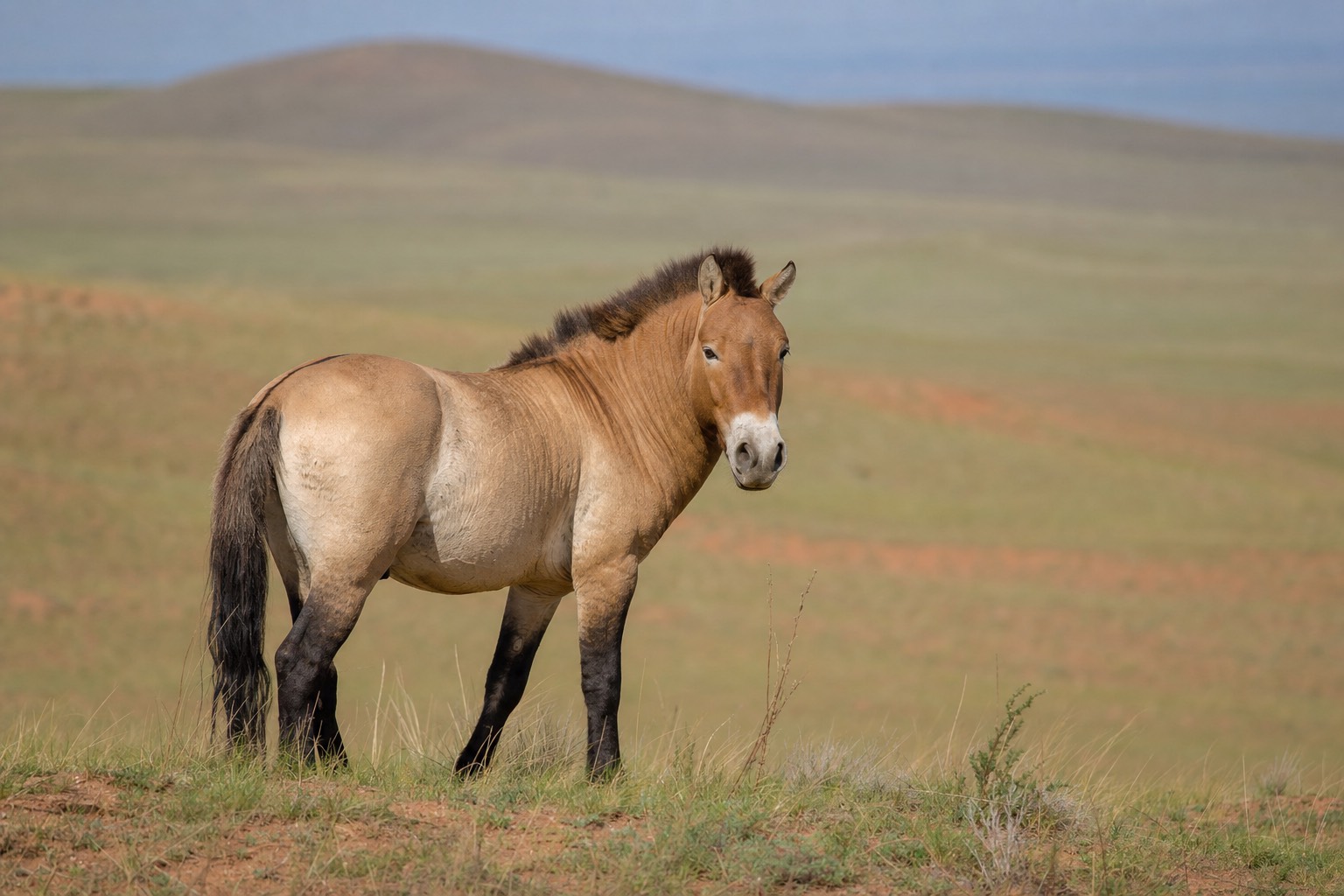
What is Przewalski's horse?
Przewalski's horse, known in Mongolia as the takhi, is the only living horse never domesticated. It went extinct in the wild in 1969, was bred back from about a dozen zoo founders, and was reintroduced to Hustai National Park in 1992. It carries 66 chromosomes, wears a dun coat, and is Mongolia's national animal.
I have lost count of how many times a visitor has pointed at a takhi and said it looks like a horse from a cave painting. They are not wrong. The stocky body, the short upright mane, the sandy coat: this is close to what a wild horse looked like before people ever put a rope on one. What follows is the whole story, the biology and the near-death and the return, told the way I tell it in the vehicle before we crest the first ridge.
What is Przewalski's horse?
Przewalski's horse, called the takhi in Mongolia, is the world's only living horse that was never domesticated. It is a stocky, dun-coloured wild horse with a dark erect mane, no forelock, and a dorsal stripe. Named after the Russian explorer who documented it for Western science, it is now the national animal of Mongolia and an endangered species.
The animal earned its scientific fame after Nikolai Przhevalsky's 1879 expedition into Central Asia brought specimens to the attention of researchers, as recorded in the Przewalski's horse entry at Wikipedia. Mongolians, of course, had known the takhi for centuries. The word takhi means "spirit" or "worthy of worship," which tells you how the horse sits in the culture here.
The name trips up almost every English speaker who tries it. If you want to say it out loud without stumbling, our short pronunciation guide for Przewalski and Hustai has you covered before your trip.
How did the takhi go extinct in the wild and come back?
The takhi was declared extinct in the wild in 1969, surviving only in zoos. Conservationists bred the captive population back up from roughly a dozen founder animals, then reintroduced horses to Mongolia. The first takhi returned to Hustai National Park in 1992. The species has since re-established free-ranging herds and been downlisted from the brink.
This is the part that gets people. By the mid-twentieth century, hunting, harsh winters, and competition with livestock had wiped the takhi from the wild. Every takhi alive today traces back to a tiny founder group of wild-caught horses, which the Smithsonian's National Zoo puts at 14 founders captured between the early and mid-1900s. Genetic studies cited in 2025 narrow the effective founder count to about 12.
The recovery is measured in IUCN status changes. The species was rated extinct in the wild for decades, moved to critically endangered in 2008 as reintroduced herds took hold, and was reclassified as endangered in 2011, which is where it stands on the IUCN Red List today. The full story of that rescue is told in our takhi comeback feature.
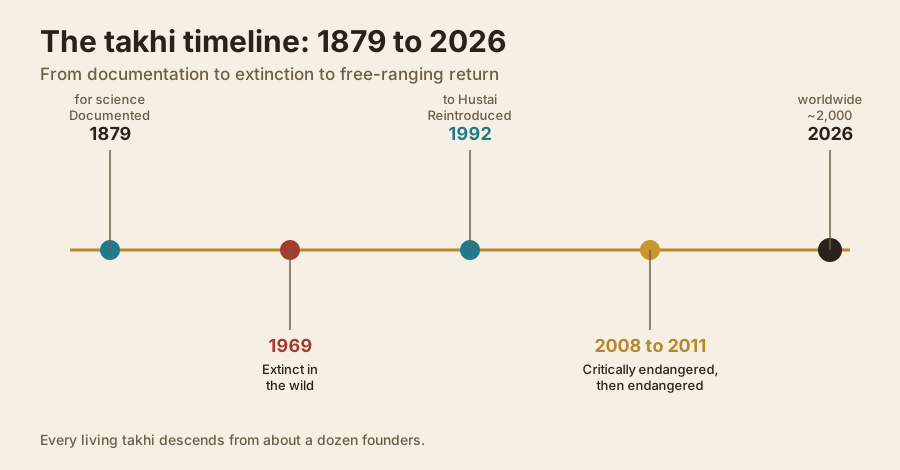
Here is that timeline as a table, which is how many of my guests prefer to hold the dates.
| Year | Milestone |
|---|---|
| 1879 | Documented for Western science after Przhevalsky's expedition |
| Mid-1900s | Last wild-caught founders taken into captivity |
| 1969 | Declared extinct in the wild |
| 1992 | First takhi reintroduced to Hustai National Park |
| 2008 | IUCN reclassifies as critically endangered |
| 2011 | IUCN reclassifies as endangered |
| 2026 | Free-ranging herds across Mongolia, China, and Russia |
What makes a takhi different from a domestic horse?
A takhi has 66 chromosomes against the domestic horse's 64, and the two can interbreed to produce fertile offspring with 65. The takhi is stockier, with a large head, a short erect mane and no forelock, a dun coat, and a dark dorsal stripe. It has never been ridden or tamed, and it lives in wild harems led by a dominant stallion.
The chromosome difference is the headline fact, and it is real. Despite it, the two lineages are close enough to cross, which is part of why the debate over the takhi's exact ancestry stays lively. The physical differences are easy to spot once you know them. A domestic horse flops its mane to one side and grows a forelock between the ears. A takhi's mane stands straight up like a brush, and the face is bare. The build is heavier, more like a large pony than a riding horse.
| Trait | Takhi | Domestic horse |
|---|---|---|
| Chromosomes | 66 | 64 |
| Mane | Short, erect, no forelock | Long, falls to one side, forelock |
| Coat | Dun with dorsal stripe | Highly variable |
| Build | Stocky, large head | Slimmer, lighter head |
| Domesticated | Never | Yes, for thousands of years |
| Can be ridden | No | Yes |
Because the animal cannot be ridden, the question I hear most is whether anyone has ever tried. They have, and it has never worked, a point we cover in the guide on whether you can ride a Przewalski's horse.
Where do Przewalski's horses live now?
The largest free-ranging population lives at Hustai National Park in Mongolia, roughly 380 to 450 horses, followed by the Great Gobi B reserve with over 350. China's reintroduced herds have passed 900 animals, and Russia's Orenburg steppes hold a smaller group. The global total sits near 2,000, all descended from the same founders.
Mongolia is the heart of the range because this is where the takhi came from and where it was first returned. Hustai is the flagship, both for its herd size and for how reachable it is from Ulaanbaatar. China now holds the single largest national share after decades of its own reintroduction work. The spread of the population across three countries is deliberate insurance against a single catastrophe wiping out the species again.
| Location | Approximate population | Notes |
|---|---|---|
| Hustai National Park, Mongolia | 380 to 450 | Largest self-sustaining wild herd |
| Great Gobi B, Mongolia | 350+ | Second Mongolian free-ranging site |
| China | 900+ | Roughly a third of the global total |
| Russia (Orenburg) | ~125 | Newer reintroduction effort |
| Global total | ~2,000 | All from ~12 founders |
For the running tally and how it has climbed decade by decade, see our dedicated piece on how many Przewalski's horses are left.
If reading about the takhi has you wanting to stand in front of one, the practical move is a timed trip out of the capital. You can book the private day trip like the Private Hustai Day Tour and check live availability and prices on Viator for a dawn or dusk departure when the harems are active.
How do takhi live in the wild?
Takhi live in family groups called harems, each led by a dominant stallion guarding a band of mares and their foals. Hustai's herd is organised into 34 such harems. Bachelor stallions without a harem form loose groups of their own. The horses graze steppe grasses through the day, watering at valley streams, and foals are born in the warm months.
Understanding the harem structure changes how you watch them. That stallion on the ridge is not posing, he is on guard, scanning for rival males and for threats to his foals. When a young stallion challenges an older one, the fights are real and sometimes bloody, and the loser drifts off to join the bachelors until he is strong enough to try again. Mares stay with a harem for years, and a stable band can hold a valley for a whole season.
Their diet is pure steppe: grasses and hardy forbs, supplemented by whatever the season offers. In winter they paw through snow to reach frozen grass, which is part of why the coldest months are so punishing on the herd. This resilience is exactly what let the species survive on the open plains for millennia before people nearly finished it off.
How do you see them at Hustai?
Visit Hustai National Park, about 100 km west of Ulaanbaatar, on a 1.5 to 2 hour drive. Go at dawn or dusk in spring or autumn, when the harems come down to the valleys. A park guide accompanies every wildlife drive, and you must keep 200 to 300 metres from the horses. Sightings are strong but never guaranteed.
The horses set their own schedule around the light and the heat. Midday in summer, they climb to shaded high ground and are hard to find. Early and late, they graze the valley floors where a slow drive can bring you within binocular range. I position guests uphill and downwind, cut the engine, and wait. The wider case for why the park is worth the early start is laid out in our take on whether Hustai is worth visiting.
What field marks actually identify a takhi at a distance?
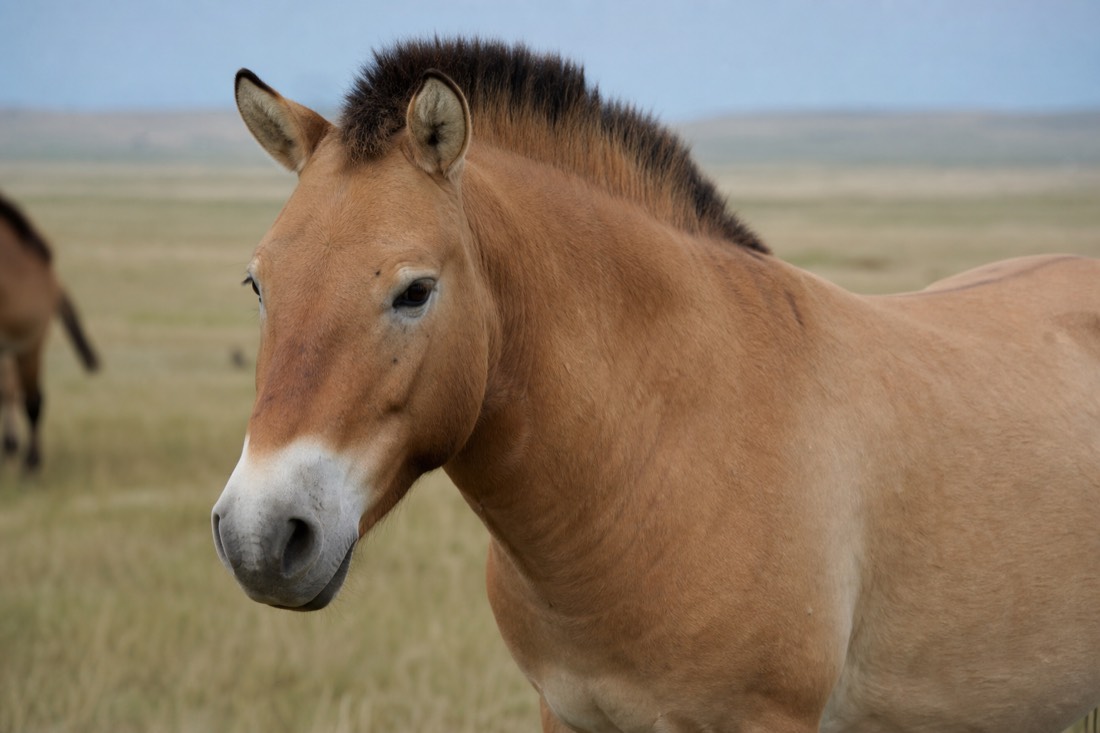
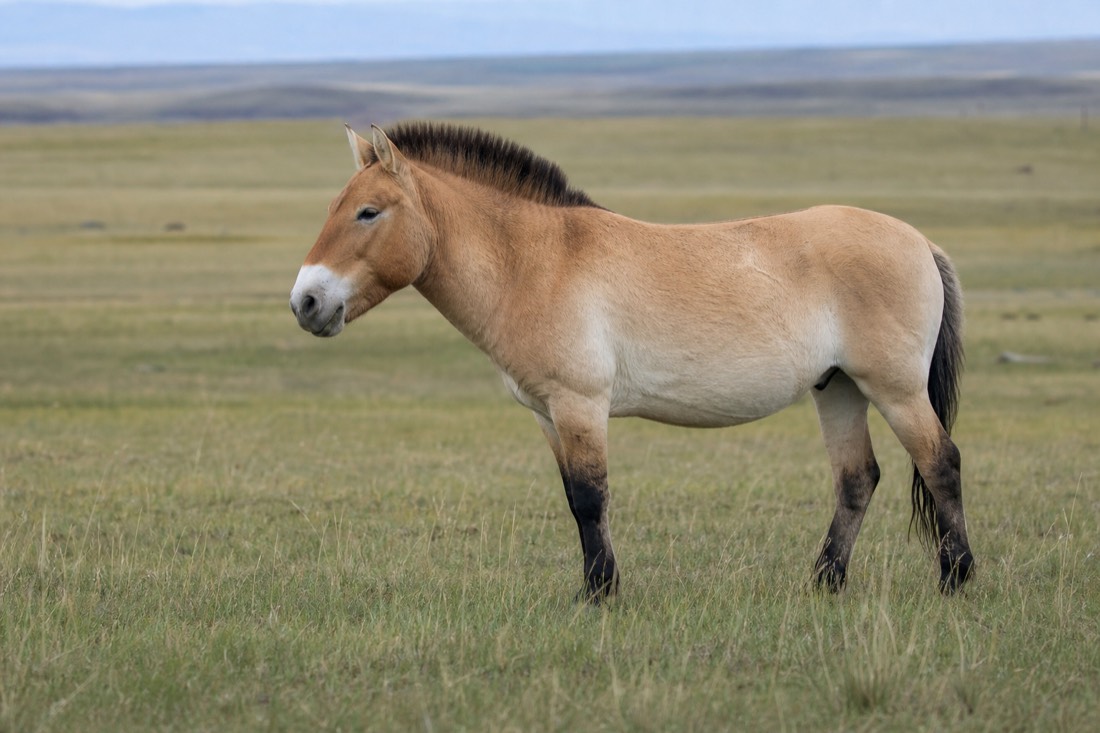
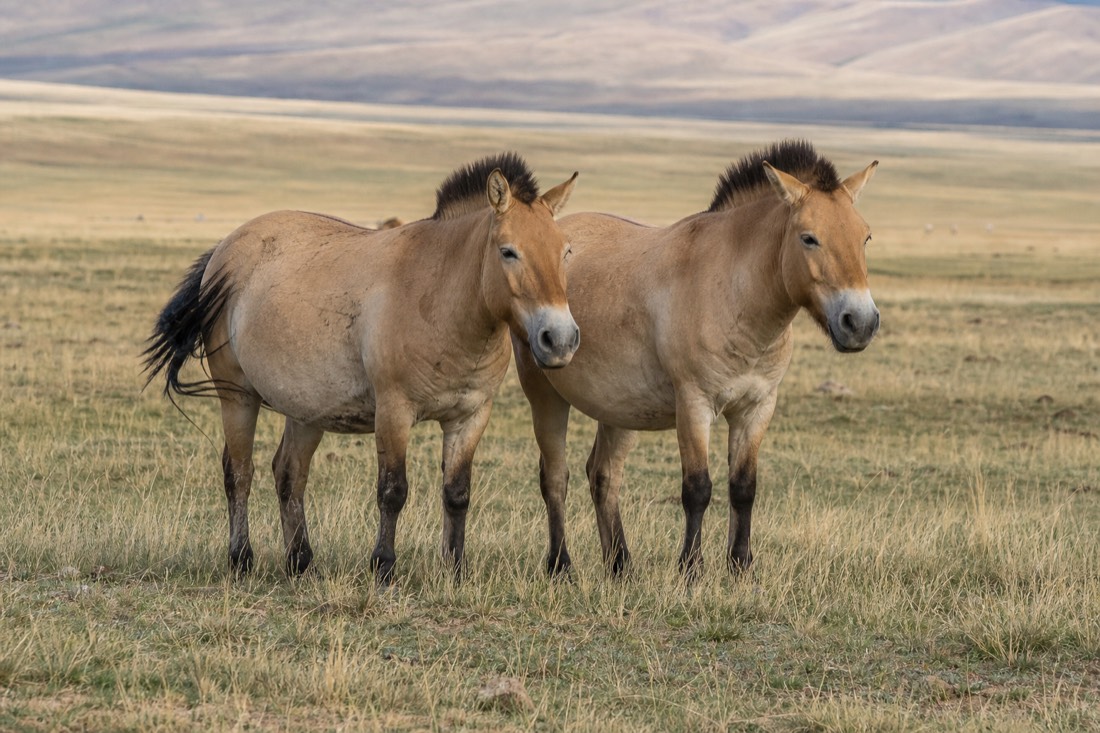
A takhi shows five reliable field marks even from far away: a dun coat, a short dark mane that stands straight up with no forelock, a pale almost-white muzzle, dark lower legs, and a dark dorsal stripe running down the spine. No domestic horse combines all five.
Field identification matters more than it sounds like it should, because from a few hundred metres a dun-coloured domestic horse can look confusingly similar at first glance. Guides learn to check the legs and muzzle first, since those two features rarely vary in a takhi and rarely align together in a domestic animal. The erect mane is the giveaway once a horse turns side-on: nothing else on the steppe holds its mane straight up like a brush rather than letting it fall.
| Field mark | Takhi | Typical domestic horse |
|---|---|---|
| Coat | Dun (sandy, tan) | Highly variable colour |
| Mane | Short, dark, stands erect, no forelock | Long, falls to one side, has a forelock |
| Muzzle | Pale, almost white | Variable, rarely uniformly pale |
| Lower legs | Dark, almost black | Variable |
| Dorsal stripe | Present, dark line down the back | Rare or absent |
| Build | Stocky, heavy head, large jaw | Slimmer, more varied body types |
Distance and light change how useful each mark is, which is worth knowing before your first drive. At dusk, coat colour washes out fast and a dun takhi can read as a dull grey-brown blur, so the dark legs and pale muzzle become the two marks that still hold up when the light fails. In full midday sun, the erect mane is often the easiest cue, since it creates a visible silhouette break along the neckline that a fallen domestic mane never produces. Guides tend to call an animal off two or three marks together rather than one, since any single feature can be misread from far enough away.
How small was the genetic bottleneck behind every living takhi?
Every takhi alive today descends from a founder population estimated at 12 to 14 individuals, captured from the wild between roughly 1898 and 1960 depending on the source. That narrow base is why the species carries elevated inbreeding risk even now, decades into recovery.
Two respected sources give slightly different numbers, and both are worth citing honestly rather than picking one. The Smithsonian's National Zoo puts the founder count at 14, captured between 1910 and 1960. A 2025 genetics paper in the Animals journal narrows it to 12 wild-caught survivors captured between 1898 and 1947, with the possibility of a few additional domestic-horse founders mixed in early on. Either figure describes the same reality: a species that passed through a bottleneck small enough to fit in a single corral, and every horse grazing at Hustai today carries that legacy in its genome.
| Source | Founder estimate | Capture window |
|---|---|---|
| Smithsonian's National Zoo | 14 | 1910 to 1960 |
| Animals journal (2025 genetics study) | 12 | 1898 to 1947 |
Conservationists manage breeding across zoos and reserves worldwide specifically to slow the effects of that bottleneck, spreading the limited gene pool as widely as the population allows rather than letting any one herd become too closely related within itself.
A bottleneck this narrow has real consequences beyond the history books. With so few ancestors behind the whole species, harmful recessive traits have fewer places to hide, and fertility across a population can run lower than in a species with a broader gene pool. That is the practical reason breeding across Hustai, the Great Gobi B, China's reserves, and zoos worldwide is coordinated rather than left to chance: moving individual horses between sites, or planning which stallion pairs with which mares, is how conservationists keep the gene pool from narrowing further. It is unglamorous, spreadsheet-level work sitting behind every harem you actually see on a drive through the park.
What are the most common myths about the takhi?
The biggest myths are that the takhi is just a wild mustang, that it can be tamed with enough patience, that any horse roaming rural Mongolia is a takhi, and that the species is still extinct in the wild. None of these hold up against the facts covered in this guide.
I hear versions of all four on almost every drive, usually stated as confident fact rather than a genuine question. Correcting them gently, early in a visit, tends to sharpen how much people notice once the horses are actually in view.
| Myth | Fact |
|---|---|
| The takhi is just a wild mustang or feral horse | The takhi was never domesticated; mustangs descend from escaped domestic stock |
| Enough patience could tame a takhi | No takhi has ever been successfully tamed or ridden, despite historic attempts |
| Any wild-looking horse in the Mongolian countryside is a takhi | Those are domestic herding horses; takhi live only in reintroduction sites like Hustai |
| The species is still extinct in the wild | Extinct in the wild only from 1969 to 1992; now endangered, not extinct |
| The takhi and Przewalski's horse are two different animals | Same species; takhi is the Mongolian name, Przewalski's horse the Western scientific name |
| Only Mongolia has takhi | Free-ranging herds also live in China and Russia, plus a self-sustaining group in Chernobyl |
I add that last one because visitors who have done their homework on Hustai sometimes assume the whole species lives inside this one park, and correcting that actually raises the stakes of what they are watching rather than lowering them. China's reintroduced herds have grown past 900 animals, roughly a third of every takhi alive, and Russia's Orenburg steppes hold a smaller, newer population. Hustai's harems are not the last takhi on Earth. They are the largest single free-ranging group of a species that conservationists deliberately spread across three countries so that no single winter, disease, or disaster could ever threaten the whole recovery at once.
The naming confusion deserves its own line, since it trips up more visitors than any of the biology. Guests arrive having read about "Przewalski's horse" online and are surprised to hear their guide say "takhi" throughout the drive, assuming for a moment that a second, separate animal must be hiding somewhere in the park. It is one animal with two names attached by two different histories: takhi from the Mongolian people who never stopped knowing it, Przewalski's horse from the Russian explorer whose 1879 expedition brought it to Western science. Both names are correct, and Mongolians overwhelmingly prefer takhi, which is the word this guide favours throughout.
What cultural status does the takhi hold in Mongolia?
The takhi is the official national animal of Mongolia. Its name translates roughly as "spirit" or "worthy of worship," and the species carries real symbolic weight here as a marker of strength and freedom, well beyond its role as a conservation success story.
That status is not a tourism talking point invented for visitors, it predates the reintroduction by centuries. The reverence shows up in how Mongolians talk about the animal, distinct from the practical, working relationship people have with domestic herding horses. International audiences got a glimpse of that relationship through the 2000 documentary "Wild Horses of Mongolia," directed by Nigel Cole and filmed with a nomadic Mongolian family, which introduced the takhi's story to viewers who had never heard of Hustai.
| Cultural touchpoint | Detail |
|---|---|
| National animal | Official national animal of Mongolia |
| Name meaning | "Takhi" translates roughly as "spirit" or "worthy of worship" |
| International recognition | Subject of the 2000 documentary "Wild Horses of Mongolia," directed by Nigel Cole, filmed with a nomadic family |
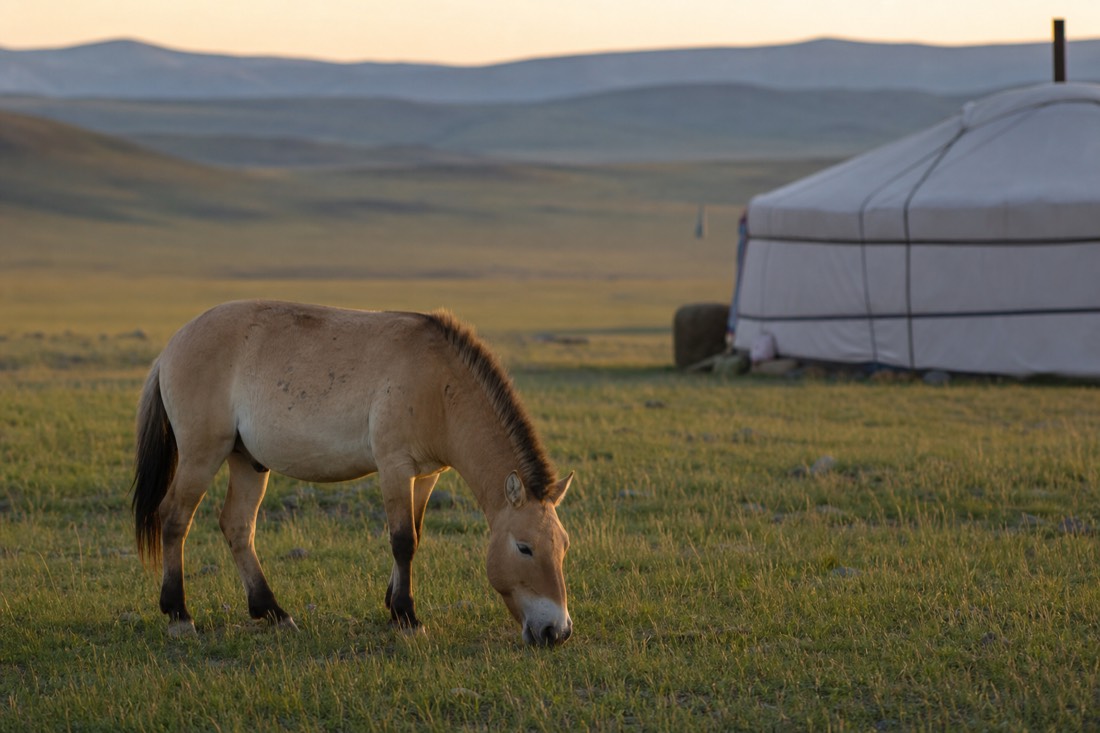
The framing as strength, freedom, and resilience is not a marketing gloss either. It maps onto the actual biography of the animal: a species that vanished entirely from the wild, survived on a dozen zoo horses, and walked back onto its home steppe within living memory. I watch that context land with visitors more than almost anything else I explain on a drive. Once someone understands that the horse in front of them carries a national symbol's weight in Mongolia and a near-extinction story in its genes, the sighting stops being just a photo opportunity and starts feeling like the reason people fly here in the first place.
Frequently asked questions about the takhi
Is Przewalski's horse the same as a wild mustang? No. Mustangs are feral, descended from escaped domestic horses. The takhi was never domesticated, which makes it the only truly wild horse alive.
Why does the takhi have 66 chromosomes? It is simply a separate lineage with a different chromosome count. It can still cross with domestic horses to produce fertile offspring carrying 65, which fascinates geneticists.
How many takhi are left in the world? Around 2,000 animals across Mongolia, China, and Russia, all descended from roughly a dozen founders that survived in captivity.
Can you visit Hustai in one day from Ulaanbaatar? Yes. The park is about 100 km west of the city, a 1.5 to 2 hour drive, and a day trip timed for dawn or dusk gives you a real chance at the horses.